_1753256285958.png)

_1754990596544.webp)
Metal Dog Hook Process
 2025-12-21 22:38:51
For buyers in the fields of bags and outdoor equipment, the purchasing decision of metal dog hooks depends not only on the price, but also on the professional understanding of the process, the process directly determines the durability, adaptability, and cost rationality of the product. According to the 2024 "China Hardware Accessories Procurement White Paper", procurement errors caused by not grasping the core points of the process account for 53% of hardware accessory procurement disputes, with mismatched molding processes and substandard surface treatment being the main issues.

Raw Material Pretreatment: core indicators that buyers must check
Raw material pretreatment is the basis of the quality of metal dog hooks, and buyers need to pay attention to the standardization of raw material screening and pretreatment processes to avoid subsequent product failures caused by raw material defects. The core value of this link is to remove raw material impurities through pretreatment, unify properties, and provide a stable substrate for subsequent processes, which directly affects the mechanical properties and life of dog hooks.
The raw material determines the basic performance of the dog hook, and it is necessary to ask the supplier to provide a complete raw material test report when purchasing. and focus on verifying the following indicators to avoid "shoddy quality":

①Composition compliance: Select materials according to needs (such as 304 stainless steel, brass H68, zinc alloy Zamak3), and confirm that the composition meets the standards through spectral analysis, for example, 304 stainless steel needs to ensure a chromium content of 18%-20%, nickel content of 8%-10.5% (in accordance with GB/T 3280-2021), copper content of brass H68 needs to be ≥67%, and impurity lead content ≤ 0.03% (to avoid heavy metals exceeding the standard affecting exports).
②Physical properties up to standard: Suppliers are required to provide tensile tests and hardness test reports, such as the tensile strength of aluminum alloy 7075 needs to be ≥ 570MPa, and the hardness of zinc alloy Zamak3 needs to be ≥ 65HB.
③Dimensional tolerance control: The diameter/thickness tolerance of raw materials (such as stainless steel wire rods, brass plates) needs to be ≤±0.05mm, and can be randomly sampled during procurement, verified by caliper measurement, and too too-large tolerance can easily lead to subsequent molding size deviations, affecting the adaptability to the package.
Molding Process
Die Casting Molding Process
Die casting is the main forming method for zinc alloy and aluminum alloy dog hooks. This process rapidly injects molten metal into the mold cavity under high pressure (typically 40-80 MPa), cools and solidifies to form a product. The hot chamber die casting machine is suitable for zinc alloy, with high production efficiency and a single piece forming time that can be controlled in 30-60 seconds. Cold chamber die casting machines are used for aluminum alloy machining and can handle materials with high melting points, although slightly less efficiently.
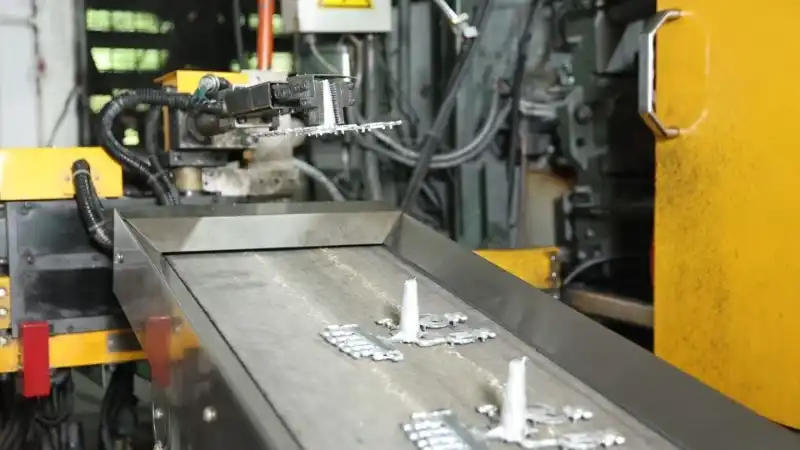
The advantage of the die casting process is that it can form complex shapes in one go, with high dimensional accuracy and good surface finish, which is especially suitable for the production of snap hooks and rotary hooks with complex mechanical structures. The control of process parameters, including the liquid metal temperature (typically 380-420°C), injection speed, and mold temperature, requires fine adjustments based on product structure and material properties.
Stamping Process
Dog hooks made of stainless steel and brass materials mainly use the stamping process. The process starts with plates or strips and gradually shapes them through processes such as punching, bending, and stretching. The multi-station progressive die can complete multiple processes on a single punch machine, with extremely high production efficiency, producing 60-120 pieces per minute. The stamping process has high requirements for the plasticity of the material, and it is necessary to choose the appropriate annealing state.

In process design, it is necessary to reasonably arrange the forming sequence to avoid excessive thinning or cracking of the material. For simple shapes such as O-rings and D-rings, it can be completed by stamping in a single process; Complex snap hooks require a combination of 5-8 processes. Rebound control of stamped parts is a technical difficulty, and experienced suppliers will ensure dimensional accuracy through die compensation angles and shaping processes.
Forging and Machining Processes< /h3>
Dog hooks in high-strength application scenarios may use forging processes. Hot forging or warm forging can improve the tissue structure of the material, increase strength and toughness, and is especially suitable for heavy-duty dog hooks for large dogs. The forged product needs to be machined to achieve precision dimensions, such as turning, milling, and drilling. CNC machining ensures consistency in critical dimensions, such as the shaft bore diameter of the snap hook and the spring groove width. For small batches of customized Products, direct machining is also a feasible solution, although the cost is high, but the flexibility is good.

Surface Treatment Process
Electroplating Process

Electroplating is the most common surface treatment for metal dog hooks, providing both decorative and protective properties. Pre-plating treatment includes degreasing, pickling, and activation to ensure a good bond between the plating layer and the substrate. Nickel plating is a basic process, typically using a two-layer nickel plating system of semi-bright nickel and bright nickel, with a total thickness of 10-15μm, providing basic corrosion resistance. A thin, hard chrome plating layer (0.3-0.5μm) provides a bright appearance and wear resistance, and is commonly found on high-gloss products. Black nickel plating creates a matte black effect, combining fashion and protective properties. Colored plating, such as rose gold and gunmetal, is achieved through PVD (physical vapor deposition) technology, resulting in a hard and stable coating, but at a significantly higher cost. Buyers should select the appropriate electroplating solution based on their target market and usage environment, and should also pay attention to the supplier's environmental protection capabilities, as electroplating wastewater treatment is a key compliance requirement.
Spraying and Painting Processes< /h3>
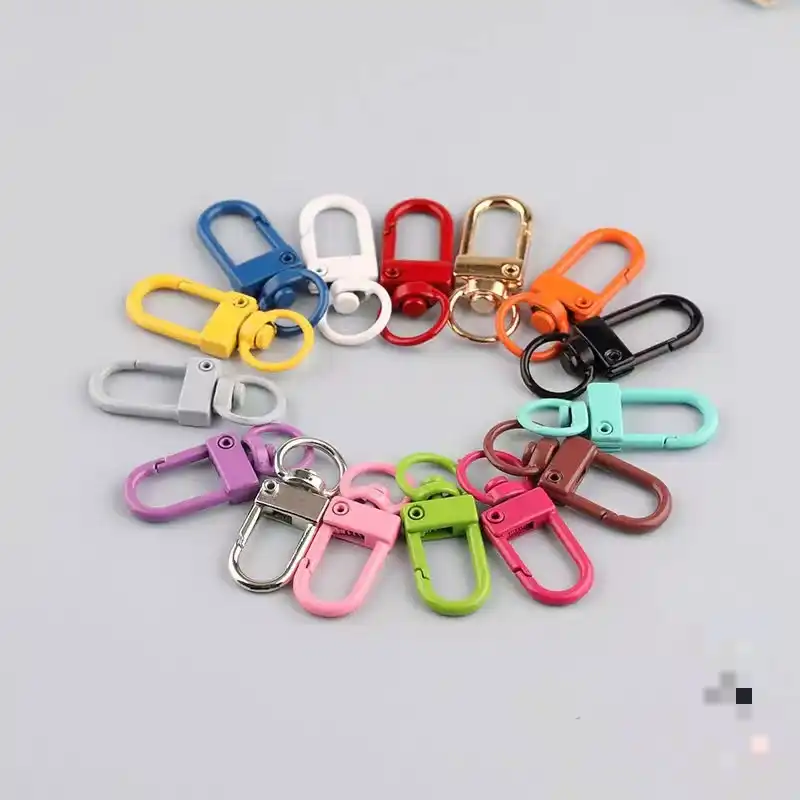
Powder spraying is suitable for aluminum alloy and steel dog hooks. The powder coating adheres to the product surface through electrostatic attraction and then cures at high temperatures to form a uniform coating. Coating thicknesses range from 50-80μm, offering excellent impact and weather resistance and a wide range of color options. Liquid spray paints offer a more refined surface finish, enabling the creation of various special effects such as metallic shimmer and pearlescent luster. UV-curable coatings are increasingly used, offering fast curing times and low VOC emissions, aligning with environmental trends. Surface treatment quality inspections include adhesion testing (Baige Grid), salt spray testing, and colorimetry. Responsible suppliers conduct random inspections of each batch and maintain records.
Polishing and Passivation
Stainless steel dog hooks are typically polished mechanically or electrolytically to achieve a bright finish. Mechanical polishing uses progressively finer grinding wheels and polishing pastes to achieve a mirror-like finish, but is labor-intensive. Electrolytic polishing uses electrochemical action to dissolve surface protrusions, automatically creating a smooth surface. It is highly efficient and offers consistent quality. After polishing, passivation forms a dense oxide film on the stainless steel surface, significantly improving corrosion resistance. For zinc alloy products, the tumbling process can also be used, where the product and abrasive are placed in a drum for tumbling to remove burrs in batches and improve surface finish.

The process of the metal dog hook is the core basis for buyers to judge quality, control costs, and match needs. For buyers, there is no need to master complex production technology, but it is necessary to clarify the "key control points" and "identification methods" of each process link, and establish the correspondence of "demand-process-quality". Only in this way can we accurately select the type in procurement, avoid risks, and lay the foundation for the quality and competitiveness of downstream packaging products.
At Carol Metal, we understand that every brand has unique design requirements. That's why we specialize in customized hardware solutions for handbags, purses, and accessories. Our 22mm inner width metal dog hook for bags is made from high-quality zinc alloy, featuring a sleek and durable finish in slip gold or NF nickel. Since our establishment in 2015, we've continuously invested in professional talent and advanced technology to deliver innovative and reliable products to both domestic and international markets. With our own electroplating factory, we ensure exceptional surface finishing, strict quality control, and flexible customization, all under one roof. Partner with a manufacturer that values precision and style. Contact tony@carolxiao.com to get your custom order started today and experience why Carol Metal is trusted by designers and manufacturers worldwide.
References
China Foundry Association. Die Casting Technology Manual. Beijing: Machinery Industry Press, 2020.
Zhang Minghua, Li Xiaodong. Metal Surface Treatment Technology and Application. Shanghai: Chemical Industry Press, 2019.
Liu Jianguo. Practical Technology of Stamping Process and Die Design. Beijing: National Defense Industry Press, 2021.
European Commission. REACH Regulation (EC) No. 1907/2006 and its amendments. 2024 Edition.
U.S. Consumer Product Safety Commission. CPSIA Regulatory Requirements and Test Methods Guide. 2023 Update.